Apparently, the Chinese character for listening is made up of other characters (or perhaps traces of characters) for the ear, the eye, and the heart. That surely suggests something vital about listening. And listening is a skill that is in desperately short supply in this era of overstimulation and information overload.
One of the worst pieces of advice in recent years came in the Malcolm Gladwell book Blink in which he described the phenomenon of ‘thin-slicing’ people when you meet them by just getting a quick gut read on them in a matter of seconds or nano-seconds and then assuming that you’ve got all you need to know. Malcolm argues that thin-slicing is a reasonably accurate way of checking someone out.
Of course, if everyone did that, none of us would ever listen to anyone again. We’d save loads of time, and we’d learn virtually nothing about the external world. It’s a recipe for global disaster from an otherwise brilliant writer.
Which brings me back to listening and that Chinese character. We don’t need to listen less, or faster; we need to listen to each other more, and more deeply. We need to hear, and appreciate, and learn, each other’s stories. If you don’t think so, ask yourself this: when are you going to start paying attention? In the next life, whatever that is?
We need to listen to each other because life is precious, and short. We need to listen to each other because despite our superficial disagreements and differences, we humans are still the best hope and the gravest danger for the planet we call home. We need to listen to each other because we need to work together in peace in order to build a better world. We need to listen to each other because lives need to be shared, we are a communal species, and isolation kills.
Please. When you listen, listen with your whole body. Use your ears, of course, but also use your eye and your heart. Listen for the facts, of course, but also listen for the underlying emotions and values of the other person. Only when you listen that carefully and deeply can you begin to understand and then communicate with another person. I don’t know if the Chinese character for listening really does include the characters for the ear, the eye, and the heart, but I do know that listening needs to include all those things.
Let's start listening better to one another and maybe -- just maybe -- we can save this magical planet and the precious, irreplaceable people on it.
With thanks to Dr. Liane Davey for explaining the Chinese character to me.
Reposted from; http://publicwords.typepad.com/nickmorgan/2012/09/thin-slicing-malcolm-gladwell-and-the-chinese-character-for-listening.html
Showing posts with label environment. Show all posts
Showing posts with label environment. Show all posts
Tuesday, September 11, 2012

Tuesday, October 25, 2011
Crowded Earth: how many is too many?
Already straining to host seven billion souls, Earth is set to teem with billions more, and only a revolution in the use of resources can avert an environmental crunch, experts say.
As early as 1798, Thomas Malthus gloomily forecast that our ability to reproduce would quickly outstrip our ability to produce food, leading to mass starvation and a culling of the species.
But an industrial revolution and its impact on agriculture proved Malthus and later doomsayers wrong, even as our numbers doubled and redoubled with accelerating frequency.
"Despite alarmist predictions, historical increases in population have not been economically catastrophic," notes David Bloom, a professor in the Department of Global Health and Population at Harvard.
Today, though, it seems reasonable to ask if Malthus wasn't simply a couple of centuries ahead of the curve.
On October 31, the world's population is officially scheduled to hit seven billion -- a rise of two billion in less than a quarter century.
Over six decades, the global fertility rate has roughly halved, and amounts to a statistical 2.5 children per woman today.
But this varies greatly from country to country. And whether the planet's population eventually stabilises at nine, 10 or 15 billion depends on what happens in developing countries, mostly in Africa, with the fastest growth.

As our species has expanded, so has its devouring of the planet's bounty, from fresh water and soil richness to forests and fisheries.
At its current pace, humankind will need, by 2030, a second planet to satisfy its appetites and absorb its waste, the Global Footprint Network (GFN) calculated last month.
And through the coal, oil and gas that drive prosperity, we are also emitting greenhouse gases that alter the climate, potentially maiming the ecosystems which feed us.
"From soaring food prices to the crippling effects of climate change, our economies are now confronting the reality of years of spending beyond our means," GFN's president, Mathis Wackernagel, said.
French diplomat Brice Lalonde, one of two coordinators for next June's UN Conference on Sustainable Development, dubbed "Rio+20," said Earth's population rise poses a fundamental challenge to how we use resources.
"In 2030 there will be at least another billion people on the planet," Lalonde said.
"The question is, how do we boost food security and provide essential services to the billion poorest people but without using more water, land or energy?"
This is why, he said, Rio+20 will focus on practical things such as increasing cleaner sources in the world energy mix, smarter use of fresh water, building cities that are environmentally friendlier and raising farm yields without dousing the soil with chemicals.
But such options dwell far more on the impact of population growth than on the problem itself.
Braking fertility rates would help the human tally stabilise at eight billion and haul poor countries out of poverty, ease the strain on natural resources and reduce climate vulnerability, say advocates.
For some experts, voluntary birth control is the key.
Geoff Dabelko, director of the Environmental Change and Security Programme at the Woodrow Wilson Center in Washington, cites Somalia as a case study of what happens when women have no access to contraception.
Racked by civil war and poverty, its population is projected to grow from about 10 million today to 22.6 million by 2050. It has the eighth-highest birth rate in the world and an average of seven children per family.
Even before the country fell into a full-fledged crisis, a third of its children were severely underweight, according to UNICEF. Ninety-nine percent of married Somali women have no access to family planning.
Many economists, though, argue that the answer lies more in reducing poverty and boosting education, especially of women.
A 2010 study in Colombia found family planning explained less than 10 percent of the country's fertility fall. The real driver was improved standards of living.
Even so, at summits that seek to shape Earth's future, tackling population growth head-on is almost taboo.
"When I attended the UN environment conference in Stockholm (in 1972), the No. 1 item on the agenda was out-of-control population growth," recalled Paul Watson, head of Sea Shepherd Conservation Society, a radical green group.
"When I attended the 1992 conference (in Rio), it wasn't even on the agenda. No one talked about it any more."
Demography was similarly absent from the UN's 2002 Johannesburg Summit, when Earth's population had climbed to six billion.
Why does "how many is too much" remain absent from the top tables?
One perceived reason is the opposition by religious conservatives to contraception or abortion. Politicians, too, may see no mileage in addressing an issue that will only cause them headaches and yield benefits several decades away.
But for some critics, population measures are synonymous with the mistakes of coercive sterilisation in India in the 1970s or China's "one child" policy, which has led to a gender imbalance in favour of boys.
As early as 1798, Thomas Malthus gloomily forecast that our ability to reproduce would quickly outstrip our ability to produce food, leading to mass starvation and a culling of the species.
But an industrial revolution and its impact on agriculture proved Malthus and later doomsayers wrong, even as our numbers doubled and redoubled with accelerating frequency.
"Despite alarmist predictions, historical increases in population have not been economically catastrophic," notes David Bloom, a professor in the Department of Global Health and Population at Harvard.
Today, though, it seems reasonable to ask if Malthus wasn't simply a couple of centuries ahead of the curve.
On October 31, the world's population is officially scheduled to hit seven billion -- a rise of two billion in less than a quarter century.
Over six decades, the global fertility rate has roughly halved, and amounts to a statistical 2.5 children per woman today.
But this varies greatly from country to country. And whether the planet's population eventually stabilises at nine, 10 or 15 billion depends on what happens in developing countries, mostly in Africa, with the fastest growth.
As our species has expanded, so has its devouring of the planet's bounty, from fresh water and soil richness to forests and fisheries.
At its current pace, humankind will need, by 2030, a second planet to satisfy its appetites and absorb its waste, the Global Footprint Network (GFN) calculated last month.
And through the coal, oil and gas that drive prosperity, we are also emitting greenhouse gases that alter the climate, potentially maiming the ecosystems which feed us.
"From soaring food prices to the crippling effects of climate change, our economies are now confronting the reality of years of spending beyond our means," GFN's president, Mathis Wackernagel, said.
French diplomat Brice Lalonde, one of two coordinators for next June's UN Conference on Sustainable Development, dubbed "Rio+20," said Earth's population rise poses a fundamental challenge to how we use resources.
"In 2030 there will be at least another billion people on the planet," Lalonde said.
"The question is, how do we boost food security and provide essential services to the billion poorest people but without using more water, land or energy?"
This is why, he said, Rio+20 will focus on practical things such as increasing cleaner sources in the world energy mix, smarter use of fresh water, building cities that are environmentally friendlier and raising farm yields without dousing the soil with chemicals.
But such options dwell far more on the impact of population growth than on the problem itself.
Braking fertility rates would help the human tally stabilise at eight billion and haul poor countries out of poverty, ease the strain on natural resources and reduce climate vulnerability, say advocates.
For some experts, voluntary birth control is the key.
Geoff Dabelko, director of the Environmental Change and Security Programme at the Woodrow Wilson Center in Washington, cites Somalia as a case study of what happens when women have no access to contraception.
Racked by civil war and poverty, its population is projected to grow from about 10 million today to 22.6 million by 2050. It has the eighth-highest birth rate in the world and an average of seven children per family.
Even before the country fell into a full-fledged crisis, a third of its children were severely underweight, according to UNICEF. Ninety-nine percent of married Somali women have no access to family planning.
Many economists, though, argue that the answer lies more in reducing poverty and boosting education, especially of women.
A 2010 study in Colombia found family planning explained less than 10 percent of the country's fertility fall. The real driver was improved standards of living.
Even so, at summits that seek to shape Earth's future, tackling population growth head-on is almost taboo.
"When I attended the UN environment conference in Stockholm (in 1972), the No. 1 item on the agenda was out-of-control population growth," recalled Paul Watson, head of Sea Shepherd Conservation Society, a radical green group.
"When I attended the 1992 conference (in Rio), it wasn't even on the agenda. No one talked about it any more."
Demography was similarly absent from the UN's 2002 Johannesburg Summit, when Earth's population had climbed to six billion.
Why does "how many is too much" remain absent from the top tables?
One perceived reason is the opposition by religious conservatives to contraception or abortion. Politicians, too, may see no mileage in addressing an issue that will only cause them headaches and yield benefits several decades away.
But for some critics, population measures are synonymous with the mistakes of coercive sterilisation in India in the 1970s or China's "one child" policy, which has led to a gender imbalance in favour of boys.
Wednesday, August 17, 2011
Ten Somali children a day die in Ethiopia's Kobe refugee camp
Ten Somali children under the age of five are dying every day of hunger-related causes in a refugee camp in Ethiopia, according to the UN refugee agency.
UNHCR reported the "alarming" increase in the number of deaths at Kobe camp after completing an assessment this week. The main cause was malnutrition, although a measles outbreak has contributed to the high mortality rate.
The camp, one of four in Dollo Adow in south-east Ethiopia, opened in June when Somalis fleeing drought and conflict poured over the border in large numbers. Kobe reached its 25,000 capacity in a month, and while new arrivals from Somalia are being directed elsewhere the death toll is not slowing.
In a briefing in Geneva, UNHCR said the average of ten deaths a day stretched back to late June, meaning that at least 500 young children had died in less than two months.
 Most of the Somali refugees arriving in Ethiopia are from rural areas, and many have never used formal health facilities before. Ron Redmond, a UNHCR spokesman in Nairobi, said this was a factor in the high death rate because parents did not know what to do with their malnourished children, even after receiving initial treatment and handouts of therapeutic food.
"Parents are told they need to sustain the supplementary feeding but they don't always do it," said Redmond. "Ensuring that they treat their kids and bring them back to health centres in a large camp is difficult and labour intensive."
Separately, some 17,500 Somalis have crossed into the Gode and Afder areas of Ethiopia, 150 miles north-east of Dollo Adow, in the past six weeks.
The continued exodus and growing death toll from the famine in Somalia is raising fresh questions about the culpability of the al-Shabaab insurgent group, which controls most of the southern part of the country. Though the causes of the famine or near-famine conditions in southern Somalia are numerous – including drought, high food prices and the absence of a government for two decades – the al-Qaida-linked Islamist movement has played a significant role.
Initially known for its effective guerrilla campaign against occupying Ethiopian forces, al-Shabaab became increasingly extreme once the enemy withdrew, with militants enforcing mosque attendance and carrying out amputations and stonings of alleged criminals, some of them teenagers. By assassinating local journalists, they ensured that the motivations and makeup of their forces have remained murky.
In 2009, al-Shabaab banned a number of aid groups, including the UN World Food Programme, for alleged offences ranging from spying to being anti-Muslim and distorting the local economy. Numerous humanitarian workers were also killed, ensuring that even groups with permission to work had to scale back their activities and withdraw non-Somali staff.
The restrictions and security concerns meant millions of Somalis had no safety net when the drought really began to bite early this year. In the worst-hit areas, there was no food distribution or help in obtaining water.
In early July the rebels said all aid agencies would be allowed to assist with drought relief, but then backtracked, saying the earlier ban on certain organisations stood. They also denied that famine was occurring.
Interviews with refugees who fled Somalia for Kenya revealed that in some areas al-Shabaab militias had tried to prevent people from leaving to seek outside help, even those pushed close to death by hunger. A new report by Human Rights Watch confirmed these findings.
Despite withdrawing the bulk of their forces from Mogadishu earlier this month in a "tactical" move, al-Shabaab still controls most of southern Somalia. While more aid is getting into the country, some of the worst-affected areas are still without assistance.
UNHCR reported the "alarming" increase in the number of deaths at Kobe camp after completing an assessment this week. The main cause was malnutrition, although a measles outbreak has contributed to the high mortality rate.
The camp, one of four in Dollo Adow in south-east Ethiopia, opened in June when Somalis fleeing drought and conflict poured over the border in large numbers. Kobe reached its 25,000 capacity in a month, and while new arrivals from Somalia are being directed elsewhere the death toll is not slowing.
In a briefing in Geneva, UNHCR said the average of ten deaths a day stretched back to late June, meaning that at least 500 young children had died in less than two months.
 Most of the Somali refugees arriving in Ethiopia are from rural areas, and many have never used formal health facilities before. Ron Redmond, a UNHCR spokesman in Nairobi, said this was a factor in the high death rate because parents did not know what to do with their malnourished children, even after receiving initial treatment and handouts of therapeutic food.
"Parents are told they need to sustain the supplementary feeding but they don't always do it," said Redmond. "Ensuring that they treat their kids and bring them back to health centres in a large camp is difficult and labour intensive."
Separately, some 17,500 Somalis have crossed into the Gode and Afder areas of Ethiopia, 150 miles north-east of Dollo Adow, in the past six weeks.
The continued exodus and growing death toll from the famine in Somalia is raising fresh questions about the culpability of the al-Shabaab insurgent group, which controls most of the southern part of the country. Though the causes of the famine or near-famine conditions in southern Somalia are numerous – including drought, high food prices and the absence of a government for two decades – the al-Qaida-linked Islamist movement has played a significant role.
Initially known for its effective guerrilla campaign against occupying Ethiopian forces, al-Shabaab became increasingly extreme once the enemy withdrew, with militants enforcing mosque attendance and carrying out amputations and stonings of alleged criminals, some of them teenagers. By assassinating local journalists, they ensured that the motivations and makeup of their forces have remained murky.
In 2009, al-Shabaab banned a number of aid groups, including the UN World Food Programme, for alleged offences ranging from spying to being anti-Muslim and distorting the local economy. Numerous humanitarian workers were also killed, ensuring that even groups with permission to work had to scale back their activities and withdraw non-Somali staff.
The restrictions and security concerns meant millions of Somalis had no safety net when the drought really began to bite early this year. In the worst-hit areas, there was no food distribution or help in obtaining water.
In early July the rebels said all aid agencies would be allowed to assist with drought relief, but then backtracked, saying the earlier ban on certain organisations stood. They also denied that famine was occurring.
Interviews with refugees who fled Somalia for Kenya revealed that in some areas al-Shabaab militias had tried to prevent people from leaving to seek outside help, even those pushed close to death by hunger. A new report by Human Rights Watch confirmed these findings.
Despite withdrawing the bulk of their forces from Mogadishu earlier this month in a "tactical" move, al-Shabaab still controls most of southern Somalia. While more aid is getting into the country, some of the worst-affected areas are still without assistance.
Thursday, April 14, 2011
NEC To Focus On New Ideas For 'Green Brunei'
Asia Inc Forum has officially announced the date for the next National Environment Conference, and also given details on what is to be expected.
Now in its fourth year, the National Environment Conference (NEC) will take place at the Rizqun International Hotel on June 8, with the theme "Green Brunei: New Ideas for a Sustainable Country".
The conference will focus on the state of the environment and the priorities for Brunei including water, marine conservation, disaster preparedness, green business sustainability and youth advocacy.
It will also feature overseas speakers from Singapore and Australia who will assess how we can best adapt to our changing climate.
 The conference will coincide with the "Youth Go Green Initiative Awards", an event held to recognise the contribution of the young citizens of Brunei in promoting environmental awareness on the effects of climate change and global warming as well as stimulating their creative minds in taking action to save the environment for their future through innovative green solutions.
The 2011 Youth Go Green Initiative Awards will be founded under the theme "Saving the World, Saving Our Future", and is organised in collaboration with the Science, Technology and Environment Partnership (STEP) Centre, Ministry of Education.
Another feature at the upcoming NEC will be the "Green Showcase", an exhibition of initiatives or programmes by Asia Inc Forum's corporate partners and local businesses in promoting products and services, which will be open to the public.
Also to be showcased are the outstanding and shortlisted entries of the 2011 Youth Go Green Initiative Awards and projects by the next generation, including the "ISB Short Eco Video Competition" which aims to educate the public about the importance and relevance of taking action and adopting a green lifestyle.
For more information and to register for the conference, the awards or the exhibition, you can visit Asia Inc Forum's website, www.asiaincforum.com.
Now in its fourth year, the National Environment Conference (NEC) will take place at the Rizqun International Hotel on June 8, with the theme "Green Brunei: New Ideas for a Sustainable Country".
The conference will focus on the state of the environment and the priorities for Brunei including water, marine conservation, disaster preparedness, green business sustainability and youth advocacy.
It will also feature overseas speakers from Singapore and Australia who will assess how we can best adapt to our changing climate.
 The conference will coincide with the "Youth Go Green Initiative Awards", an event held to recognise the contribution of the young citizens of Brunei in promoting environmental awareness on the effects of climate change and global warming as well as stimulating their creative minds in taking action to save the environment for their future through innovative green solutions.
The 2011 Youth Go Green Initiative Awards will be founded under the theme "Saving the World, Saving Our Future", and is organised in collaboration with the Science, Technology and Environment Partnership (STEP) Centre, Ministry of Education.
Another feature at the upcoming NEC will be the "Green Showcase", an exhibition of initiatives or programmes by Asia Inc Forum's corporate partners and local businesses in promoting products and services, which will be open to the public.
Also to be showcased are the outstanding and shortlisted entries of the 2011 Youth Go Green Initiative Awards and projects by the next generation, including the "ISB Short Eco Video Competition" which aims to educate the public about the importance and relevance of taking action and adopting a green lifestyle.
For more information and to register for the conference, the awards or the exhibition, you can visit Asia Inc Forum's website, www.asiaincforum.com.
Tuesday, February 22, 2011
A Mother’s Plea – Mother Earth, That Is.
A major US science conference was held last Sunday, whereby concerns were raised over the effect of a continually growing population on the planet. The United Nations has predicted that by the end of this year, the global population would have reached seven billion – and may escalate to nine billion by the year 2050.
What does this mean? Basically a rapid growth in the population would lead to an increase in food production – however, bear in mind that we already have a scarcity in resources as it is. If current trends carry on as they have been, by the year 2050 our children and grandchildren could very well be residing in an unrecognizable world.

Being that incomes are expected to rise as well in the coming decades- tripling globally and quintupling in developing nations- this development ensures added strain to global food supplies.
To feed all those mouths, we will need to produce as much food in the next 40 years as we have in the last 8,000! People tend to move up the food chain as their incomes rise, consuming more meat than they might have when they made less money.
It takes around seven pounds (3.4 kilograms) of grain to produce a pound of meat, and around three to four pounds of grain to produce a pound of cheese or eggs. The standing possibility is this - more people, more money, more consumption, but the same planet. Thus, scientists and governments are being urged to start making changes now on how food is produced.
Meanwhile, population experts are now calling for attention to be drawn on more funding for family planning programs to help control the growth in the number of humans, especially in developing nations.
For the past two decades, very little investment has been aimed toward family planning. However that has begun to change, partly because of the environmental factors like global warming and food prices. Minimizing population growth is one of the key factors in making a significant alteration to the predicted outcome, and the only feasible way of going about that is through effective family planning.
Our moment is here, and the time is now. Ask yourself this - what good will a pretty penny do for you and your family if we all live to see the day that the Earth is spoilt beyond recognition? Take this into consideration when you find yourself making decisions day by day, and I implore you to be a little more conscientious in the way you choose to live your life. Do it for the future of your family, and for the planet, the one home in which we thrive. Mother Earth has always been generous in providing for our needs, and it’s high time we did our part in protecting and restoring her to her splendour.
What does this mean? Basically a rapid growth in the population would lead to an increase in food production – however, bear in mind that we already have a scarcity in resources as it is. If current trends carry on as they have been, by the year 2050 our children and grandchildren could very well be residing in an unrecognizable world.

Being that incomes are expected to rise as well in the coming decades- tripling globally and quintupling in developing nations- this development ensures added strain to global food supplies.
To feed all those mouths, we will need to produce as much food in the next 40 years as we have in the last 8,000! People tend to move up the food chain as their incomes rise, consuming more meat than they might have when they made less money.
It takes around seven pounds (3.4 kilograms) of grain to produce a pound of meat, and around three to four pounds of grain to produce a pound of cheese or eggs. The standing possibility is this - more people, more money, more consumption, but the same planet. Thus, scientists and governments are being urged to start making changes now on how food is produced.
Meanwhile, population experts are now calling for attention to be drawn on more funding for family planning programs to help control the growth in the number of humans, especially in developing nations.
For the past two decades, very little investment has been aimed toward family planning. However that has begun to change, partly because of the environmental factors like global warming and food prices. Minimizing population growth is one of the key factors in making a significant alteration to the predicted outcome, and the only feasible way of going about that is through effective family planning.
Our moment is here, and the time is now. Ask yourself this - what good will a pretty penny do for you and your family if we all live to see the day that the Earth is spoilt beyond recognition? Take this into consideration when you find yourself making decisions day by day, and I implore you to be a little more conscientious in the way you choose to live your life. Do it for the future of your family, and for the planet, the one home in which we thrive. Mother Earth has always been generous in providing for our needs, and it’s high time we did our part in protecting and restoring her to her splendour.
Monday, November 1, 2010
Ultra-Efficient Danish Home Produces More Energy Than It Needs
This striking modern home located near Aarhus in Denmark packs an amazing array of green building strategies into a small footprint, allowing it to actually produce more power than it consumes. Designed and built to be super energy-efficient, smart, eco-friendly, and powered by the sun, the zero-plus Home For Life is an experiment in creating the sustainable house of the future. A family has been living in the home now for 14 months and reporting on their activities and the home's performance in order to improve the design for future iterations.
 The Home for Life is one of eight experimental buildings created by VKR Holdings to develop the sustainable home of the future. The home is designed using the Active House principle, which has a strong focus on energy-efficient design, daylighting and renewable energy generation. Every room has at least two walls with windows on it, so the home makes great use of natural daylighting. During the cool seasons, mechanical ventilation with heat recovery is used so the cold air can be heated without the use of additional energy
The home's windows cover 40 percent of the total floor area, which is twice the area of a traditional house. An Active House takes similar principles of Passive House design, but incorporates more daylighting and utilizes "smart home" devices to optimize the use of energy. It is one thing to design and build a smart and energy-efficient home, but little research has been done yet to see how livable they are. Data collected from this experiment is very important to future designs.
The family reports on how comfortable they are with the automatic controls -- when the climate was just right for them, and when the controls made it too hot or too cold.The south-facing slate roof includes the photovoltaic system, solar hot water system and skylights. The home's energy systems are all optimized and work together to minimize energy use. The roof is key to the design -- it incorporates renewable energy generation, skylights for natural lighting, and operable windows for cooling.
 The Home for Life is one of eight experimental buildings created by VKR Holdings to develop the sustainable home of the future. The home is designed using the Active House principle, which has a strong focus on energy-efficient design, daylighting and renewable energy generation. Every room has at least two walls with windows on it, so the home makes great use of natural daylighting. During the cool seasons, mechanical ventilation with heat recovery is used so the cold air can be heated without the use of additional energy
The home's windows cover 40 percent of the total floor area, which is twice the area of a traditional house. An Active House takes similar principles of Passive House design, but incorporates more daylighting and utilizes "smart home" devices to optimize the use of energy. It is one thing to design and build a smart and energy-efficient home, but little research has been done yet to see how livable they are. Data collected from this experiment is very important to future designs.
The family reports on how comfortable they are with the automatic controls -- when the climate was just right for them, and when the controls made it too hot or too cold.The south-facing slate roof includes the photovoltaic system, solar hot water system and skylights. The home's energy systems are all optimized and work together to minimize energy use. The roof is key to the design -- it incorporates renewable energy generation, skylights for natural lighting, and operable windows for cooling.
Friday, October 29, 2010
Pollution black list forces big business to act
Large multinational companies and their local suppliers in China have long been receiving criticism over environmental concerns. Part of the criticism relates to the amount of large-scale toxic pollution being created in China so that consumers in countries like Australia can have cheap goods. One man has been particularly effective in his activism and, as a result, both multinational and Chinese companies are seeking his advice on how to get their names off his list.
 Ma Jun originally became aware of China's pollution as a journalist travelling around the country. He says about half of China's water systems, rivers and lakes, are seriously contaminated. His office in southern Beijing's Guang Qu Men district houses an unassuming organisation called the Institute of Public and Environmental Affairs. His website, which simply publishes information from the Chinese government, has been creating waves around world. Mr Ma lists the names of factories which have been fined or shut down by the Chinese authorities because of pollution. He then prints the names of the international companies that buy products from those suppliers.
Chinese companies seek him out and ask what they have to do to get off his black list. Mr Ma then organises independent auditors to check their emissions. If they have cleaned up their production, he takes them off his website. His list of offenders now numbers more than 68,000 and the embarrassment it is causing multinational companies is forcing them to act.
"This database now is being used by some major companies in the world, like GE, like Nike, like Walmart, as a tool for their supply chain management," he said.
"Taking Walmart as an example - every month they are comparing their list of thousands of suppliers with our list of violators and when they identify polluters that have been openly announced by the Chinese government, what they do is they will call them, they will push them to take corrective actions and eventually make a public disclosure about what went wrong and how they tried to fix their problem," he said.
 Ma Jun originally became aware of China's pollution as a journalist travelling around the country. He says about half of China's water systems, rivers and lakes, are seriously contaminated. His office in southern Beijing's Guang Qu Men district houses an unassuming organisation called the Institute of Public and Environmental Affairs. His website, which simply publishes information from the Chinese government, has been creating waves around world. Mr Ma lists the names of factories which have been fined or shut down by the Chinese authorities because of pollution. He then prints the names of the international companies that buy products from those suppliers.
Chinese companies seek him out and ask what they have to do to get off his black list. Mr Ma then organises independent auditors to check their emissions. If they have cleaned up their production, he takes them off his website. His list of offenders now numbers more than 68,000 and the embarrassment it is causing multinational companies is forcing them to act.
"This database now is being used by some major companies in the world, like GE, like Nike, like Walmart, as a tool for their supply chain management," he said.
"Taking Walmart as an example - every month they are comparing their list of thousands of suppliers with our list of violators and when they identify polluters that have been openly announced by the Chinese government, what they do is they will call them, they will push them to take corrective actions and eventually make a public disclosure about what went wrong and how they tried to fix their problem," he said.
Monday, October 11, 2010
Three receive prestigious environment award
Three President’s Award for the Environment were given out in Singapore on Friday at the Istana by President S R Nathan.
The recipients are Hitachi Global Storage Technologies (GST) Singapore Pte Ltd, Nan Hua High School, and Singapore Polytechnic.
The award is the highest accolade in Singapore that recognises individuals, organisations and companies for their significant contributions to Singapore’s efforts in achieving environmental sustainability.
Hitachi Global Storage Technologies Singapore’s real estate site operations director Tan Puey Hwee said: "We notice that a lot of times the office air—conditioning is very cold, but employees are complaining it’s very hot because they’re all wearing jackets.
"So with support from the management, we have adjusted the temperature over time, so now a lot of employees are not wearing jackets in the office, while the temperature is set at a comfortable level".
 The company’s all—round effort has earned it the prestigious environmental award, together with Nan Hua High School and Singapore Polytechnic. This is the first time the five—year—old award is going to a polytechnic. The polytechnic’s efforts in going green include planting more trees, building a block out of re—cycled material, and installing motion sensoring devices that can dim lights. Singapore Polytechnic principal Tan Hang Cheong said: "We are going through a programme of retrofitting.
"Our buildings, many of them are 20, 30 years old, so we are gradually trying to improve. "So when we remodel the classroom, remodel the lecture theatres, we will introduce all these energy—saving devices within the buildings". Next year, the school will also introduce a module on the environment for every student to become environmentally aware.
The recipients are Hitachi Global Storage Technologies (GST) Singapore Pte Ltd, Nan Hua High School, and Singapore Polytechnic.
The award is the highest accolade in Singapore that recognises individuals, organisations and companies for their significant contributions to Singapore’s efforts in achieving environmental sustainability.
Hitachi Global Storage Technologies Singapore’s real estate site operations director Tan Puey Hwee said: "We notice that a lot of times the office air—conditioning is very cold, but employees are complaining it’s very hot because they’re all wearing jackets.
"So with support from the management, we have adjusted the temperature over time, so now a lot of employees are not wearing jackets in the office, while the temperature is set at a comfortable level".
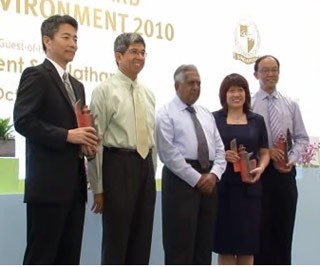 The company’s all—round effort has earned it the prestigious environmental award, together with Nan Hua High School and Singapore Polytechnic. This is the first time the five—year—old award is going to a polytechnic. The polytechnic’s efforts in going green include planting more trees, building a block out of re—cycled material, and installing motion sensoring devices that can dim lights. Singapore Polytechnic principal Tan Hang Cheong said: "We are going through a programme of retrofitting.
"Our buildings, many of them are 20, 30 years old, so we are gradually trying to improve. "So when we remodel the classroom, remodel the lecture theatres, we will introduce all these energy—saving devices within the buildings". Next year, the school will also introduce a module on the environment for every student to become environmentally aware.
Tuesday, September 21, 2010
Testers 'fabricating air pollution reports'
You have got to be kidding me!!! Fabricated air pollution reports in a highly developed and alledgedly environmentally concious country, Australia. What's next???
 A former employee of an Australian air testing company alleges data is being fabricated and fraudulently provided to regulatory bodies and is going unchecked by the government. The former employee - who has now left the industry - alleges that shortcuts were habitually taken when testing for air pollution from smoke stacks during his three-year tenure with the company.
"While I was there, there wasn't any formal training. You were thrown in the deep end and the equipment was a piecemeal piece of equipment to do what was required, but not to do anything properly.
"I even saw on numerous times my superiors turning up on site with me to do the work and then saying that they couldn't be bothered doing the sampling.
"I've also seen them, for dioxins and furans, which were very expensive tests that had to be done, instead of doing the six-hour sample I've seen them pretend to have taken samples onto filter papers."
The scientist says he and colleagues were pressured to cut corners.
"Being hurried off site, not being given enough time. If it would take a whole week to get a job completed, you would get it completed in two days because you're required elsewhere. So you were sent off somewhere else and the figures were made up so that you could get two large jobs done in a week instead of just the one."
The man says he has obtained copies of reports that support his claims since leaving the company.
And he says he believes the fraudulent behaviour is going undetected and could be widespread within the industry.
He alleges the National Association of Testing Authorities (NATA) and the Department of Environment and Resource Management are not sufficiently regulating compliance to standards.
"The Environmental Protection Agency is requesting that industry provide them with reports by NATA-accredited bodies that detail the levels of air emissions that they have," he said.
"But when these reports are submitted they are taken at face value and they're not being properly scrutinised by either NATA or the EPA. So there is nothing to show that these are being done properly, and I have evidence to show that they haven't been done properly if they were to be checked."
He says the effects of non-compliance could be detrimental for the public. "If we don't have accurate figures on what is being emitted into the air, in Gladstone for example, we have no way of knowing if levels are being exceeded past safe community levels - and the air could have high levels of lead, high levels of dioxins, of carcinogens, or poisons into the atmosphere which could then cause sickness."
The scientist also says that due to non-compliance going unchecked, councils make uninformed decisions about industry expansions. And he says similar discrepancies in air testing could be occurring in the coal seam gas industry.
"If they got the incorrect information about the amount of pollutants that are being put into the atmosphere, they are unable to accurately determine whether to go ahead with expansions, because they don't have a correct baseline to know what the air pollution levels are at any one time."
He says during his time at the company he saw large companies go from struggling to pass compliance tests, to easily passing environmental standards.
"NATA needs to start doing their job properly," he said.
"Unfortunately they're not an independent body because they are paid for by the stack testing companies themselves ... so there is no independence there. "But ideally we should look more towards the American model, where the environmental protection agency have their own sampling officers who are fully experienced in stack testing and actually will perform surprise visits to stack testing companies when they're on site, are able to audit reports, and have a requirement that raw data is included in the stack testing reports so that anyone can have a look and ensure that things are being done to the standard.
"At the moment there are no requirements that you include your raw data in Australia. And every testing company should have that data. It should be no problem for them to include it in any report that they submit, to show that things were done to the standard."
 A former employee of an Australian air testing company alleges data is being fabricated and fraudulently provided to regulatory bodies and is going unchecked by the government. The former employee - who has now left the industry - alleges that shortcuts were habitually taken when testing for air pollution from smoke stacks during his three-year tenure with the company.
"While I was there, there wasn't any formal training. You were thrown in the deep end and the equipment was a piecemeal piece of equipment to do what was required, but not to do anything properly.
"I even saw on numerous times my superiors turning up on site with me to do the work and then saying that they couldn't be bothered doing the sampling.
"I've also seen them, for dioxins and furans, which were very expensive tests that had to be done, instead of doing the six-hour sample I've seen them pretend to have taken samples onto filter papers."
The scientist says he and colleagues were pressured to cut corners.
"Being hurried off site, not being given enough time. If it would take a whole week to get a job completed, you would get it completed in two days because you're required elsewhere. So you were sent off somewhere else and the figures were made up so that you could get two large jobs done in a week instead of just the one."
The man says he has obtained copies of reports that support his claims since leaving the company.
And he says he believes the fraudulent behaviour is going undetected and could be widespread within the industry.
He alleges the National Association of Testing Authorities (NATA) and the Department of Environment and Resource Management are not sufficiently regulating compliance to standards.
"The Environmental Protection Agency is requesting that industry provide them with reports by NATA-accredited bodies that detail the levels of air emissions that they have," he said.
"But when these reports are submitted they are taken at face value and they're not being properly scrutinised by either NATA or the EPA. So there is nothing to show that these are being done properly, and I have evidence to show that they haven't been done properly if they were to be checked."
He says the effects of non-compliance could be detrimental for the public. "If we don't have accurate figures on what is being emitted into the air, in Gladstone for example, we have no way of knowing if levels are being exceeded past safe community levels - and the air could have high levels of lead, high levels of dioxins, of carcinogens, or poisons into the atmosphere which could then cause sickness."
The scientist also says that due to non-compliance going unchecked, councils make uninformed decisions about industry expansions. And he says similar discrepancies in air testing could be occurring in the coal seam gas industry.
"If they got the incorrect information about the amount of pollutants that are being put into the atmosphere, they are unable to accurately determine whether to go ahead with expansions, because they don't have a correct baseline to know what the air pollution levels are at any one time."
He says during his time at the company he saw large companies go from struggling to pass compliance tests, to easily passing environmental standards.
"NATA needs to start doing their job properly," he said.
"Unfortunately they're not an independent body because they are paid for by the stack testing companies themselves ... so there is no independence there. "But ideally we should look more towards the American model, where the environmental protection agency have their own sampling officers who are fully experienced in stack testing and actually will perform surprise visits to stack testing companies when they're on site, are able to audit reports, and have a requirement that raw data is included in the stack testing reports so that anyone can have a look and ensure that things are being done to the standard.
"At the moment there are no requirements that you include your raw data in Australia. And every testing company should have that data. It should be no problem for them to include it in any report that they submit, to show that things were done to the standard."
Saturday, September 18, 2010
Green driving
Most people are quite concerned about the state of our natural environment these days, and with good reason.
 We are all looking for ways to lessen our impact on the environment and to be more well informed citizens of the world; well, most of us anyway. There are many ways to “go green” and to lead a more environmentally friendly lifestyle, but most of us don’t think about the fuel consumption when driving our car as a way of going green. Most people just look at it as a way of cutting fuel cost, however, driving green has great benefits for the environment. Here are a few tips that will help you reduce your fuel cost AND reduce your impact on the environment:
Pay attention to traffic: Speeding, accelerating and braking hard can deplete efficiency by 33%
Underinflated tires: Tires that are underinflated by 20% increases fuel consumption with 5-10%. Check your car's manual to find out how much air should be in your tires.
Aircondition increases the fuel consumption with up to 15%
Empty your trunk: Driving with extra weight in the trunk can increase the fuel consumption with up to 5%
These tips will help you reduce your car's fuel consumption, but of course it would be better for the environment (and your wallet) if you don't drive your car at all and take the bus, your bicycle or set up car pooling with your collegues.
 We are all looking for ways to lessen our impact on the environment and to be more well informed citizens of the world; well, most of us anyway. There are many ways to “go green” and to lead a more environmentally friendly lifestyle, but most of us don’t think about the fuel consumption when driving our car as a way of going green. Most people just look at it as a way of cutting fuel cost, however, driving green has great benefits for the environment. Here are a few tips that will help you reduce your fuel cost AND reduce your impact on the environment:
Pay attention to traffic: Speeding, accelerating and braking hard can deplete efficiency by 33%
Underinflated tires: Tires that are underinflated by 20% increases fuel consumption with 5-10%. Check your car's manual to find out how much air should be in your tires.
Aircondition increases the fuel consumption with up to 15%
Empty your trunk: Driving with extra weight in the trunk can increase the fuel consumption with up to 5%
These tips will help you reduce your car's fuel consumption, but of course it would be better for the environment (and your wallet) if you don't drive your car at all and take the bus, your bicycle or set up car pooling with your collegues.
Thursday, September 9, 2010
The benefits of wild salmon vs. farmed salmon
For all the sea food lovers out there - Are the health risks of eating the commonly sold farmed salmon? It could seem like, you should check whether the salmon you buy is farmed or wild.
Salmon farming, which involves raising salmon in containers placed under water near shore, began in Norway about 50 years ago and has since caught on in the U.S., Ireland, Canada, Chile and the United Kingdom. Due to the large decline in wild fish from overfishing, many experts see the farming of salmon and other fish as the future of the industry. On the flip side, many marine biologists and ocean advocates fear such a future, citing serious health and ecological implications with so-called "aquaculture."
George Mateljan, founder of Health Valley Foods says that farmed fish are "far inferior" to their wild counterparts. "Despite being much fattier, farmed fish provide less usable beneficial omega 3 fats than wild fish," he says. Indeed, U.S. Department of Agriculture research bears out that the fat content of farmed salmon is 30-35 percent by weight while wild salmons' fat content is some 20 percent lower, though with a protein content about 20 percent higher. And farm-raised fish contain higher amounts of pro-inflammatory omega 6 fats instead of the preponderance of healthier omega 3s found in wild fish.
 "Due to the feedlot conditions of aquafarming, farm-raised fish are doused with antibiotics and exposed to more concentrated pesticides than their wild kin," reports Mateljan. He adds that farmed salmon are given a salmon-colored dye in their feed "without which their flesh would be an unappetizing grey color." Some aquaculture proponents claim that fish farming eases pressure on wild fish populations, but most ocean advocates disagree. To wit, one National Academy of Sciences study found that sea lice from fish farming operations killed up to 95% of juvenile wild salmon migrating past them. And two other studies -- one in western Canada and the other in England -- found that farmed salmon accumulate more cancer-causing PCBs and dioxins than wild salmon due to pesticides circulating in the ocean that get absorbed by the sardines, anchovies and other fish that are ground up as feed for the fish farms. A recent survey of U.S. grocery stores found that farmed salmon typically contains 16 times the PCBs found in wild salmon; other studies in Canada, Ireland and Great Britain reached similar conclusions.
Another problem with fish farms is the liberal use of drugs and antibiotics to control bacterial outbreaks and parasites. These primarily synthetic chemicals spread out into marine ecosystems just from drifting in the water column as well as from fish feces. In addition, millions of farmed fish escape fish farms every year around the world and mix into wild populations, spreading contaminants and disease accordingly.
Who would have known that fish farms are actually that bad to the environment? And that the fish are far from being as healthy as their wild counterpart. I will for sure be checking next time I buy salmon!!
Salmon farming, which involves raising salmon in containers placed under water near shore, began in Norway about 50 years ago and has since caught on in the U.S., Ireland, Canada, Chile and the United Kingdom. Due to the large decline in wild fish from overfishing, many experts see the farming of salmon and other fish as the future of the industry. On the flip side, many marine biologists and ocean advocates fear such a future, citing serious health and ecological implications with so-called "aquaculture."
George Mateljan, founder of Health Valley Foods says that farmed fish are "far inferior" to their wild counterparts. "Despite being much fattier, farmed fish provide less usable beneficial omega 3 fats than wild fish," he says. Indeed, U.S. Department of Agriculture research bears out that the fat content of farmed salmon is 30-35 percent by weight while wild salmons' fat content is some 20 percent lower, though with a protein content about 20 percent higher. And farm-raised fish contain higher amounts of pro-inflammatory omega 6 fats instead of the preponderance of healthier omega 3s found in wild fish.
 "Due to the feedlot conditions of aquafarming, farm-raised fish are doused with antibiotics and exposed to more concentrated pesticides than their wild kin," reports Mateljan. He adds that farmed salmon are given a salmon-colored dye in their feed "without which their flesh would be an unappetizing grey color." Some aquaculture proponents claim that fish farming eases pressure on wild fish populations, but most ocean advocates disagree. To wit, one National Academy of Sciences study found that sea lice from fish farming operations killed up to 95% of juvenile wild salmon migrating past them. And two other studies -- one in western Canada and the other in England -- found that farmed salmon accumulate more cancer-causing PCBs and dioxins than wild salmon due to pesticides circulating in the ocean that get absorbed by the sardines, anchovies and other fish that are ground up as feed for the fish farms. A recent survey of U.S. grocery stores found that farmed salmon typically contains 16 times the PCBs found in wild salmon; other studies in Canada, Ireland and Great Britain reached similar conclusions.
Another problem with fish farms is the liberal use of drugs and antibiotics to control bacterial outbreaks and parasites. These primarily synthetic chemicals spread out into marine ecosystems just from drifting in the water column as well as from fish feces. In addition, millions of farmed fish escape fish farms every year around the world and mix into wild populations, spreading contaminants and disease accordingly.
Who would have known that fish farms are actually that bad to the environment? And that the fish are far from being as healthy as their wild counterpart. I will for sure be checking next time I buy salmon!!
Monday, September 6, 2010
Clean Up the World Weekend 2010
In 2010 the campaign's flagship event; Clean Up the World Weekend will be held from the 17-19 of September.
Clean Up the World is a community based environmental campaign that inspires and empowers communities from every corner of the globe to clean up, fix up and conserve their environment.
 Now in its 18th year, Clean Up the World, held in conjunction with the United Nations Environment Programme (UNEP), mobilises an estimated 35 million volunteers from 120 countries annually, making it one of the largest community-based environmental campaigns in the world. The campaign brings together businesses, community groups, schools, governments and individuals in a range of activities and programs that positively improve local environments.
Since the first Clean Up the World campaign in 1993 the improvements achieved due to the efforts of millions of concerned volunteers around the world have been astounding. Examples of community-led Clean Up the World activities include:
• Recycling and resource recovery
• Tree planting
• Education campaigns
• Water reuse and conservation
• Competitions
• Exhibitions
• Fix up projects.
Clean Up the World encourages participants to organise an activity on, or around this weekend and celebrate their environmental achievements.
Getting involved is easy! Communities can conduct activities such as clean up events or organise environmental awareness raising activities. Groups, organisations, businesses and communities around the world unite and take action at a local level to address the global issue of climate change.
Check out the Clean Up the World for events in your community as well as information on how to register YOUR event: www.cleanuptheworld.org
Clean Up the World is a community based environmental campaign that inspires and empowers communities from every corner of the globe to clean up, fix up and conserve their environment.
 Now in its 18th year, Clean Up the World, held in conjunction with the United Nations Environment Programme (UNEP), mobilises an estimated 35 million volunteers from 120 countries annually, making it one of the largest community-based environmental campaigns in the world. The campaign brings together businesses, community groups, schools, governments and individuals in a range of activities and programs that positively improve local environments.
Since the first Clean Up the World campaign in 1993 the improvements achieved due to the efforts of millions of concerned volunteers around the world have been astounding. Examples of community-led Clean Up the World activities include:
• Recycling and resource recovery
• Tree planting
• Education campaigns
• Water reuse and conservation
• Competitions
• Exhibitions
• Fix up projects.
Clean Up the World encourages participants to organise an activity on, or around this weekend and celebrate their environmental achievements.
Getting involved is easy! Communities can conduct activities such as clean up events or organise environmental awareness raising activities. Groups, organisations, businesses and communities around the world unite and take action at a local level to address the global issue of climate change.
Check out the Clean Up the World for events in your community as well as information on how to register YOUR event: www.cleanuptheworld.org
Wednesday, September 1, 2010
Are our toilet habits affecting the environment?
It is estimated that in our lifetime we spend up to three years on the loo, using an average of 110 rolls each year, but new research has delved deeper to uncover the toilet habits of the nation.
The survey looked at everything from technique to differences between the sexes, but one of the biggest questions dividing the people in the survey was "Do you scrunch or fold the loo roll?". According to the research, 68% fold their toilet paper before wiping and only 15% of us scrunch it.
And the results backed up the traditional belief that women are more likely to scrunch while men are more likely to fold, but only by a bit; one fifth of women admitted to scrunching their toilet paper compared to 10% of men, whereas three quarters of men admitted to folding against 63% of women.
Age is also an interesting factor, as the results showed that the older a person gets the more likely they are to fold their loo roll - which could come down to them having a little more time to spend a penny.
 Only 57% of 18 to 24-year-olds admit to folding before wiping, whereas three quarters of those over 55-years-old claim to do the same thing. Meanwhile, men like to have something to read on the loo, 59% compared to just 43% of women. The reading material of choice is newspapers (45%), books (33%) and magazines (46%) ,whereas some of us are more high-tech reading mobile text messages (21%), internet pages on phones or laptops (17%) with others simply looking to take life less seriously, as 4% read joke books.
When it comes to waste, women are worse than men as 86% use up to 15 sheets of toilet roll every time they go to the toilet compared to 74% of men. However, 3% of men do admit to using over 25 sheets per visit which would be sure to block most toilets as well as being a complete waste and bad for the environment.
Many of those aged between 25 and 34-years-old are clearly still mummy and daddy's little angel, as 12% admitted that their parents still purchase their toilet roll for them.
And girls who live with their boyfriend should watch their supply, as the research shows 0% of boyfriends will replenish the stock if it runs out.(hmmm one can wonder what they will do if the girlfriend doesn't buy new stock!!!)
The survey looked at everything from technique to differences between the sexes, but one of the biggest questions dividing the people in the survey was "Do you scrunch or fold the loo roll?". According to the research, 68% fold their toilet paper before wiping and only 15% of us scrunch it.
And the results backed up the traditional belief that women are more likely to scrunch while men are more likely to fold, but only by a bit; one fifth of women admitted to scrunching their toilet paper compared to 10% of men, whereas three quarters of men admitted to folding against 63% of women.
Age is also an interesting factor, as the results showed that the older a person gets the more likely they are to fold their loo roll - which could come down to them having a little more time to spend a penny.
 Only 57% of 18 to 24-year-olds admit to folding before wiping, whereas three quarters of those over 55-years-old claim to do the same thing. Meanwhile, men like to have something to read on the loo, 59% compared to just 43% of women. The reading material of choice is newspapers (45%), books (33%) and magazines (46%) ,whereas some of us are more high-tech reading mobile text messages (21%), internet pages on phones or laptops (17%) with others simply looking to take life less seriously, as 4% read joke books.
When it comes to waste, women are worse than men as 86% use up to 15 sheets of toilet roll every time they go to the toilet compared to 74% of men. However, 3% of men do admit to using over 25 sheets per visit which would be sure to block most toilets as well as being a complete waste and bad for the environment.
Many of those aged between 25 and 34-years-old are clearly still mummy and daddy's little angel, as 12% admitted that their parents still purchase their toilet roll for them.
And girls who live with their boyfriend should watch their supply, as the research shows 0% of boyfriends will replenish the stock if it runs out.(hmmm one can wonder what they will do if the girlfriend doesn't buy new stock!!!)
Saturday, August 28, 2010
Can you make your pet go green???
Cats and dogs may not be immediately concerned with saving the Earth, but today's owners should find themselves engaging in green responsibility and choosing biodegradable/eco-friendly pet products. Going green isn't just for people.
 Dogs as well as dog owners can help protect the environment we all share. In America alone there were 74.8 million dogs listed in 2008. That many dogs can make a significant impact on the environment. It only makes sense that pet owners include their furry family members in lifestyle changes that protect health and the planet we live on.
Small changes can add up and here are a few tips on how you can have your pet go green:
• Adopt pets from a shelter. Those who want a specific breed can find just what they're looking for at a breed rescue.
• Pick up after your dog, using paper or biodegradable poop bags. Never use plastic, which does not break down in the landfill.
• Feed dogs organic pet food that is free of hormones and chemicals that may be toxic to the canine body.
• Recycle household materials for bedding. Some of the family's old blankets or towels work well as do old pillow slips stuffed with foam packaging peanuts.
• Pay attention to packaging of pet items. Recycled, biodegradable, or none is best.
• Use shampoos and other grooming products that are free of phosphates, sulfates, and other chemicals that can be harmful to the environment.
It might be hard for you to find the environmentally friendly pet products in your community. But how about asking your local pet shop, if they would consider taking the products in? If enought customers ask, I am sure they will give in to the pressure :-)
 Dogs as well as dog owners can help protect the environment we all share. In America alone there were 74.8 million dogs listed in 2008. That many dogs can make a significant impact on the environment. It only makes sense that pet owners include their furry family members in lifestyle changes that protect health and the planet we live on.
Small changes can add up and here are a few tips on how you can have your pet go green:
• Adopt pets from a shelter. Those who want a specific breed can find just what they're looking for at a breed rescue.
• Pick up after your dog, using paper or biodegradable poop bags. Never use plastic, which does not break down in the landfill.
• Feed dogs organic pet food that is free of hormones and chemicals that may be toxic to the canine body.
• Recycle household materials for bedding. Some of the family's old blankets or towels work well as do old pillow slips stuffed with foam packaging peanuts.
• Pay attention to packaging of pet items. Recycled, biodegradable, or none is best.
• Use shampoos and other grooming products that are free of phosphates, sulfates, and other chemicals that can be harmful to the environment.
It might be hard for you to find the environmentally friendly pet products in your community. But how about asking your local pet shop, if they would consider taking the products in? If enought customers ask, I am sure they will give in to the pressure :-)
Saturday, August 14, 2010
Is there such a thing as "fake green"??
In my work related research I have come across a very large number of business that declare themselves green or environmentally concious in their corporate social responsibility policy.
 As a consumer it can be very hard to see through the smokescreen of a company's marketing strategy and figure out which companies are dedicated the reducing their carbon footprint and which companies are using a few green iniatives to attract the modern green consumer. Eco-friendly doesn't mean anything unfortunately marketers have figured out that people are willing to pay a premium, a little more, if it says eco on it. So sometimes it does even though it may not be eco-friendly at all.
I've seen companies using "supporter of Earth Hour" to promote their green iniatives. Excuse me!!! Swithcing off the lights for ONE HOUR every year does not make your company green. It's this kind of companies, I call "fake green". They support a public green initiative and use it as proof of their green-ness. Don't let this easy bought green initiatives fool you!!
There is actually an official term for the concept: Greenwashing: It’s greenwashing when a company or organisation spends more time and money claiming to be “green” through advertising and marketing than actually implementing business practices that minimise environmental impact.
Make sure you look carefully next time you decide to buy green products. Spend some time researching the different companies before you make decide on the brand. There is plenty information available online - enough to enable you to make an informed decision!
 As a consumer it can be very hard to see through the smokescreen of a company's marketing strategy and figure out which companies are dedicated the reducing their carbon footprint and which companies are using a few green iniatives to attract the modern green consumer. Eco-friendly doesn't mean anything unfortunately marketers have figured out that people are willing to pay a premium, a little more, if it says eco on it. So sometimes it does even though it may not be eco-friendly at all.
I've seen companies using "supporter of Earth Hour" to promote their green iniatives. Excuse me!!! Swithcing off the lights for ONE HOUR every year does not make your company green. It's this kind of companies, I call "fake green". They support a public green initiative and use it as proof of their green-ness. Don't let this easy bought green initiatives fool you!!
There is actually an official term for the concept: Greenwashing: It’s greenwashing when a company or organisation spends more time and money claiming to be “green” through advertising and marketing than actually implementing business practices that minimise environmental impact.
Make sure you look carefully next time you decide to buy green products. Spend some time researching the different companies before you make decide on the brand. There is plenty information available online - enough to enable you to make an informed decision!
Thursday, August 5, 2010
US billionaires pledge 50% of their wealth to charity
Thirty-eight US billionaires have pledged at least 50% of their wealth to charity through a campaign started by investor Warren Buffett and Microsoft founder Bill Gates. They include New York Mayor Michael Bloomberg, CNN founder Ted Turner and entertainment executive Barry Diller.
"The Giving Pledge" lists all the families and individuals who have committed to the project. The site says the pledge is a "moral commitment" not a "legal contract".
Who are the billionaire philanthropists?
The campaign was started in June to convince US billionaires to give away at least half of their fortunes either during their lifetimes or after their deaths. "We've really just started but already we've had a terrific response," Mr Buffett said in a statement. He added: "The Giving Pledge is about asking wealthy families to have important conversations about their wealth and how it will be used."
Those who pledge their money to "philanthropic causes and charitable organisations" must publicly state their intention through a letter of explanation.
Other billionaires who have pledged large sums of their money include film producer George Lucas, philanthropist David Rockefeller and oil investor T Boone Pickens. "I am dedicating the majority of my wealth to improving education. It is the key to the survival of the human race," Mr Lucas wrote in his Giving Pledge letter.
The organisation says many of the donors have committed to donating sums far greater than the 50% minimum level. "While the Giving Pledge is specifically focused on billionaires, the idea takes its inspiration from efforts in the past and at present that encourage and recognize givers of all financial means and backgrounds," says Givingpledge.org.
Mr Buffett along with Mr Gates and his wife, Melinda, held numerous dinners with US billionaires in the past year to promote the campaign and urge America's financial elite to pledge.
Mr Buffett, the chief executive of the investment firm Berkshire Hathaway, pledged 99% of his money to the Bill & Melinda Gates Foundation and family charities in 2006. Forbes Magazine estimated Mr Buffett's wealth at $47bn (£29bn) in March. Bill Gates, who Forbes rates as the world's second wealthiest person, has also given away more than $28bn to his foundation.
There are 403 billionaires living in the US, according to Forbes.
"The Giving Pledge" lists all the families and individuals who have committed to the project. The site says the pledge is a "moral commitment" not a "legal contract".
Who are the billionaire philanthropists?
The campaign was started in June to convince US billionaires to give away at least half of their fortunes either during their lifetimes or after their deaths. "We've really just started but already we've had a terrific response," Mr Buffett said in a statement. He added: "The Giving Pledge is about asking wealthy families to have important conversations about their wealth and how it will be used."
Those who pledge their money to "philanthropic causes and charitable organisations" must publicly state their intention through a letter of explanation.
Other billionaires who have pledged large sums of their money include film producer George Lucas, philanthropist David Rockefeller and oil investor T Boone Pickens. "I am dedicating the majority of my wealth to improving education. It is the key to the survival of the human race," Mr Lucas wrote in his Giving Pledge letter.
The organisation says many of the donors have committed to donating sums far greater than the 50% minimum level. "While the Giving Pledge is specifically focused on billionaires, the idea takes its inspiration from efforts in the past and at present that encourage and recognize givers of all financial means and backgrounds," says Givingpledge.org.
Mr Buffett along with Mr Gates and his wife, Melinda, held numerous dinners with US billionaires in the past year to promote the campaign and urge America's financial elite to pledge.
Mr Buffett, the chief executive of the investment firm Berkshire Hathaway, pledged 99% of his money to the Bill & Melinda Gates Foundation and family charities in 2006. Forbes Magazine estimated Mr Buffett's wealth at $47bn (£29bn) in March. Bill Gates, who Forbes rates as the world's second wealthiest person, has also given away more than $28bn to his foundation.
There are 403 billionaires living in the US, according to Forbes.
Friday, July 30, 2010
5 reasons not to drink bottled water
In 2009 there was sold 73 million litres of bottled water in Singapore alone, which gives roughly150 mio plastic water bottles to dispose.
And why even buy bottled water in Singapore? With the tap water being as clean as water can be, there is no good excuse to buy the bottled version.
Here are 5 reasons why NOT to buy bottled water:
1) Bottled water isn't a good value
Branded bottled water is sold from vending machines at the same price as soft drinks. Branded bottled water is essentially filtered tap water, bottled close to their distribution point. Most municipal water costs less than 1 cent per 10 liters.
2) No healthier than tap water
While public safety groups correctly point out that many municipal water systems are aging and there remain hundreds of chemical contaminants for which no standards have been established, there's very little empirical evidence that suggests bottled water is any cleaner or better for you than its tap equivalent.
3) Bottled water means garbage
The plastic used to bottle beverages is of high quality and in demand by recyclers, However, over 80 percent of plastic bottles are simply thrown away.
That assumes empty bottles actually make it to a garbage can. Plastic waste is now at such a volume that vast eddies of current-bound plastic trash now spin endlessly in the world's major oceans. This represents a great risk to marine life, killing birds and fish which mistake our garbage for food.
Thanks to its slow decay rate, the vast majority of all plastics ever produced still exist — somewhere.
4) Bottled water means less attention to public systems
Many people drink bottled water because they don't like the taste of their local tap water, or because they question its safety.
This is like running around with a slow leak in your tire, topping it off every few days rather than taking it to be patched. Only the very affluent can afford to switch their water consumption to bottled sources. Once distanced from public systems, these consumers have little incentive to support bond issues and other methods of upgrading municipal water treatment.
5) The corporatization of water
Water is being called the "Blue Gold" of the 21st century. Thanks to increasing urbanization and population, shifting climates and industrial pollution, fresh water is becoming humanity's most precious resource.
Multinational corporations are stepping in to purchase groundwater and distribution rights wherever they can, and the bottled water industry is an important component in their drive to commoditize what many feel is a basic human right: the access to safe and affordable water.
What can you do?
There's a simple alternative to bottled water: buy a stainless steel thermos, and use it. Don't like the way your local tap water tastes? Inexpensive carbon filters will turn most tap water sparkling fresh at a fraction of bottled water's cost.
And why even buy bottled water in Singapore? With the tap water being as clean as water can be, there is no good excuse to buy the bottled version.
Here are 5 reasons why NOT to buy bottled water:
1) Bottled water isn't a good value
Branded bottled water is sold from vending machines at the same price as soft drinks. Branded bottled water is essentially filtered tap water, bottled close to their distribution point. Most municipal water costs less than 1 cent per 10 liters.
2) No healthier than tap water
While public safety groups correctly point out that many municipal water systems are aging and there remain hundreds of chemical contaminants for which no standards have been established, there's very little empirical evidence that suggests bottled water is any cleaner or better for you than its tap equivalent.
3) Bottled water means garbage
The plastic used to bottle beverages is of high quality and in demand by recyclers, However, over 80 percent of plastic bottles are simply thrown away.
That assumes empty bottles actually make it to a garbage can. Plastic waste is now at such a volume that vast eddies of current-bound plastic trash now spin endlessly in the world's major oceans. This represents a great risk to marine life, killing birds and fish which mistake our garbage for food.
Thanks to its slow decay rate, the vast majority of all plastics ever produced still exist — somewhere.
4) Bottled water means less attention to public systems
Many people drink bottled water because they don't like the taste of their local tap water, or because they question its safety.
This is like running around with a slow leak in your tire, topping it off every few days rather than taking it to be patched. Only the very affluent can afford to switch their water consumption to bottled sources. Once distanced from public systems, these consumers have little incentive to support bond issues and other methods of upgrading municipal water treatment.
5) The corporatization of water
Water is being called the "Blue Gold" of the 21st century. Thanks to increasing urbanization and population, shifting climates and industrial pollution, fresh water is becoming humanity's most precious resource.
Multinational corporations are stepping in to purchase groundwater and distribution rights wherever they can, and the bottled water industry is an important component in their drive to commoditize what many feel is a basic human right: the access to safe and affordable water.
What can you do?
There's a simple alternative to bottled water: buy a stainless steel thermos, and use it. Don't like the way your local tap water tastes? Inexpensive carbon filters will turn most tap water sparkling fresh at a fraction of bottled water's cost.
Thursday, July 15, 2010
Increase the temperature = Decrease your utility bill
When you're in a tropical climate having the aircondition on indoors is almost a must for your comfort. However, cooling down your home with airconditioning is very likely to be a significant part of your utility bill. Not only is it very expensive to cool down your home but it also puts a strain on the worlds natural resources.
 There are a few easy tips to decrease your home cooling expenditure and the most important one is to increase the temperature. It will save you up to 5% on your home cooling costs for each degree that you are able to raise your thermostat. So if you would normally put your airconditioning on at 18 degrees celcius imagine the change in you cost if you change the temperature to 23 degrees. Yes a 25% decrease in the cost of coolig down your home. Now imagine what you can do with all that money saved...
Here are another few easy tips to reduce your home cooling expenditure:- A dusty filter reduces air flow. Examine your unit's air filters once a month and clean or replace filters when necessary. Keeping your filters clean can cut energy consumption 5 to 15%.
- Minimise the area being cooled or heated by shutting doors to unused rooms
- If the machine has adjustable louvres, adjust them towards the ceiling when cooling, and towards the floor when heating (as cool air falls, hot air rises)
 There are a few easy tips to decrease your home cooling expenditure and the most important one is to increase the temperature. It will save you up to 5% on your home cooling costs for each degree that you are able to raise your thermostat. So if you would normally put your airconditioning on at 18 degrees celcius imagine the change in you cost if you change the temperature to 23 degrees. Yes a 25% decrease in the cost of coolig down your home. Now imagine what you can do with all that money saved...
Here are another few easy tips to reduce your home cooling expenditure:- A dusty filter reduces air flow. Examine your unit's air filters once a month and clean or replace filters when necessary. Keeping your filters clean can cut energy consumption 5 to 15%.
- Minimise the area being cooled or heated by shutting doors to unused rooms
- If the machine has adjustable louvres, adjust them towards the ceiling when cooling, and towards the floor when heating (as cool air falls, hot air rises)
Sunday, March 21, 2010
Consumers who choose green products to boost their status
Recently research was carried out on a group of 168 college students and what they found out is that some people who go out of their way to buy eco-friendly products do not do it for their concern of the planet but to make themselves appear superior.
Many green products are more expensive but lack some of the features of conventional products but such altruistic behavior may come from a desire to show off one's wealth and environmental consciousness.
 One group of students read a story intended to make them aspire towards a high social status, while another group read a different story or no story. Each student was asked to choose between a series of green and conventional products. The products had the same price and brand, but the green option had lower performance and fewer luxury features. Students in the "status" group were more likely to choose the green products as compared to the students in the control group. And the result of another experiment is more interesting. It showed that the status hungry students were less likely to buy green if told they were shopping online rather in a store, that is if no one is watching! (Naughty naughty..) Students in the status-seeking group were also more attracted to green products when those products were more expensive.
Maybe these students have to take a course on climate change in order to take it more seriously and understand that their future wouldn't be as comfortable if no drastic action is taken. I was shocked to find out that there are people out there who are more interested in attaining a higher status in life than concern for the environment. We still have to share the same air no matter what status you are in!
Tip of the day: Throw you recyclables in the designated recycling bin in town instaed of the regular bin :)
Many green products are more expensive but lack some of the features of conventional products but such altruistic behavior may come from a desire to show off one's wealth and environmental consciousness.
 One group of students read a story intended to make them aspire towards a high social status, while another group read a different story or no story. Each student was asked to choose between a series of green and conventional products. The products had the same price and brand, but the green option had lower performance and fewer luxury features. Students in the "status" group were more likely to choose the green products as compared to the students in the control group. And the result of another experiment is more interesting. It showed that the status hungry students were less likely to buy green if told they were shopping online rather in a store, that is if no one is watching! (Naughty naughty..) Students in the status-seeking group were also more attracted to green products when those products were more expensive.
Maybe these students have to take a course on climate change in order to take it more seriously and understand that their future wouldn't be as comfortable if no drastic action is taken. I was shocked to find out that there are people out there who are more interested in attaining a higher status in life than concern for the environment. We still have to share the same air no matter what status you are in!
Tip of the day: Throw you recyclables in the designated recycling bin in town instaed of the regular bin :)
Friday, March 19, 2010
Let's welcome the ECO-OTO
What is the Eco-Oto?
Well it's a Japanese invention that is to help those that are embarrassed with certain sounds we, as human beings, make while busy in the loo (if you know what I mean heheh).
 I know I'm one of the guilty ones that flush occasionally when I think I need to heheh. I know, too much info right but hey it's only natural! Even the most gorgeous people have their moments in the toilet! So this eco-oto is an iphone app that helps you cover up those embarrassing moments in the public toilet by playing a flushing sound so instead of actually flushing or "coughing" away, just press a button on your iphone and it will do the work for you. You can play it for 30, 60, 90 or 120 seconds! This way you will be saving around 6-8 litres of water per flush! It cost only $0.99, a small price to pay for the environment if you are one of those guilty ones that waste water doing the pretend flush :)
If you do not want to waste your money on it then try out our tip of the day and see whether it works for you :)
Tip of the day: Instead of buying the eco-oto iphone app, you could try and record the flushing sound in the comfort of your own toilet as a ringtone and play it whenever you need it. Try it out first and see whether it works ok.. and make sure it is loud enough to cover your toilet musicals!
Well it's a Japanese invention that is to help those that are embarrassed with certain sounds we, as human beings, make while busy in the loo (if you know what I mean heheh).
 I know I'm one of the guilty ones that flush occasionally when I think I need to heheh. I know, too much info right but hey it's only natural! Even the most gorgeous people have their moments in the toilet! So this eco-oto is an iphone app that helps you cover up those embarrassing moments in the public toilet by playing a flushing sound so instead of actually flushing or "coughing" away, just press a button on your iphone and it will do the work for you. You can play it for 30, 60, 90 or 120 seconds! This way you will be saving around 6-8 litres of water per flush! It cost only $0.99, a small price to pay for the environment if you are one of those guilty ones that waste water doing the pretend flush :)
If you do not want to waste your money on it then try out our tip of the day and see whether it works for you :)
Tip of the day: Instead of buying the eco-oto iphone app, you could try and record the flushing sound in the comfort of your own toilet as a ringtone and play it whenever you need it. Try it out first and see whether it works ok.. and make sure it is loud enough to cover your toilet musicals!
Subscribe to:
Posts (Atom)